
You didn’t get into tattooing for the money. Nobody does, not really. You got into it because you could do something most people couldn’t. You could look at a blank piece of skin and see what it could become. You had the eye, the hand, and the patience to turn an idea into something permanent. Something real.
And for a while, that was enough.
Then somewhere between the walk-ins and the flash sheets and the guy who wanted the same tribal armband you’ve done four hundred times, something got quiet inside you. Not loud. Not dramatic. Just quiet. Like a frequency you used to hear that slowly stopped coming through.
You’re still good at this. That part hasn’t changed. You show up, you do the work, the work is solid. But there’s a question that keeps appearing in the back of your head at the end of a long day, usually somewhere around the third hour of a session you stopped caring about an hour ago.
Is this it?
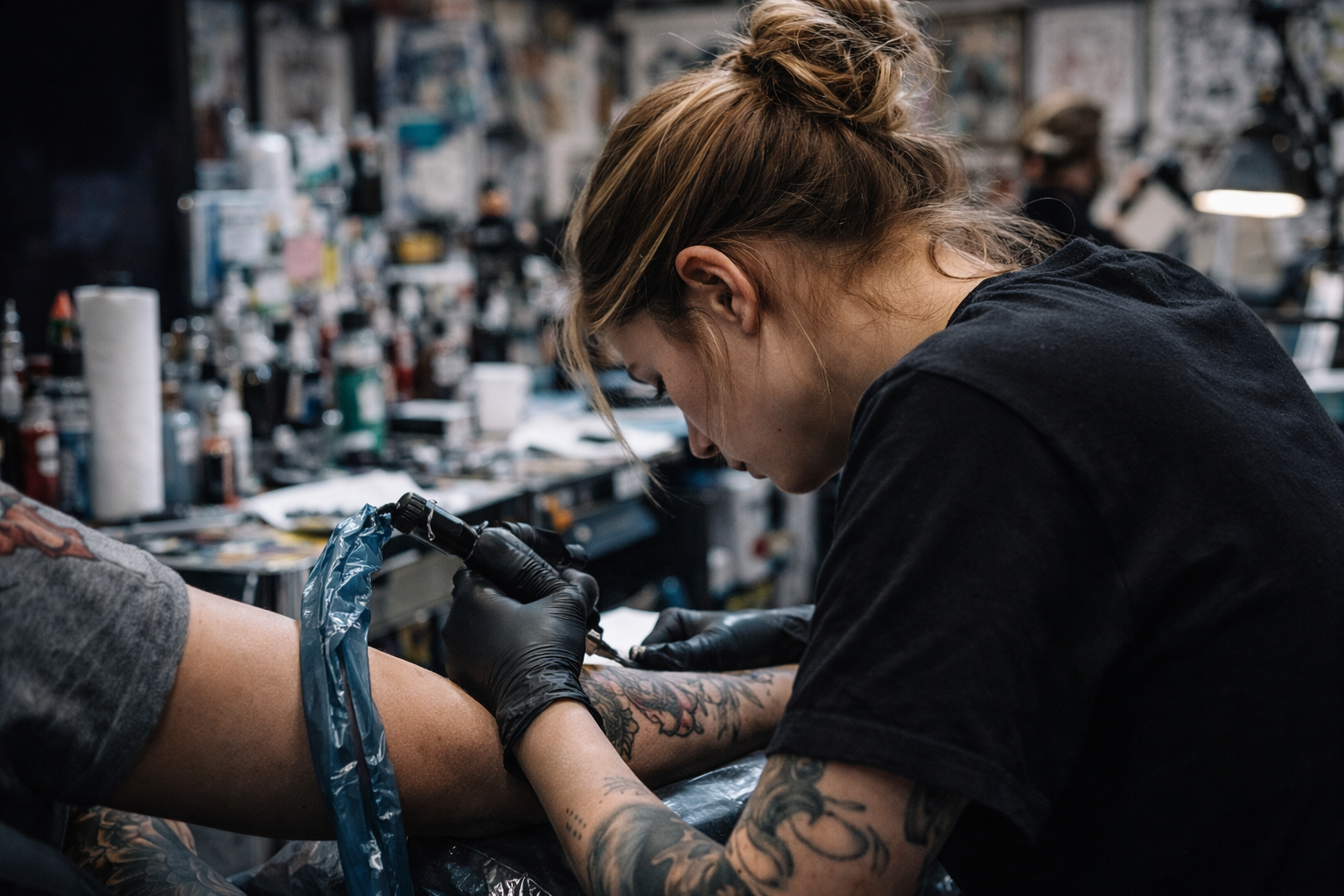
The Thing Nobody Talks About in the Tattoo World
The tattoo industry has a burnout problem it doesn’t like to admit.
It’s not trendy to say it. The culture is built around toughness, around the grind, around logging the hours and building the following and growing the clientele. Complaining about it feels like weakness. Like you don’t deserve the chair you’re sitting in.
So most artists don’t say it out loud. They just start dreading Mondays. They start going through the motions on pieces that used to excite them. They start scrolling other artists’ work and feeling something that isn’t quite inspiration. They start wondering if the thing they loved is still in there somewhere, buried under the bookings and the consultations and the client who wanted to negotiate the price on a six-hour back piece.
Physical burnout in this industry is real and documented. The back pain. The hand strain. The hours on your feet. The repetitive positions that slowly dismantle your body while you’re focused on building someone else’s. You can be thirty-five years old and move like someone twenty years older. That’s not a dramatic exaggeration. That’s Tuesday.
But the physical part isn’t actually the hardest part. The hardest part is the creative one. The part where you realize you’ve been technically executing other people’s ideas for so long that you’ve stopped having your own. The part where the craft is still sharp but the feeling behind it has gone somewhere and you’re not sure when it left or how to get it back.
What You Actually Want
You want to do work that matters beyond the session it took to complete it.
Not in a grand, pretentious way. In a simple, human way. You want to sit across from someone and know that what you’re about to do is going to change something real for them. Not just how they look in a tank top. Something deeper. Something that was missing and will now be there.
You want the technical challenge to mean something. You want the precision you’ve spent years developing to serve a purpose that goes beyond aesthetics. You want to finish a session and feel the kind of tired that comes from doing something genuinely important, not just something technically demanding.
You want to feel like an artist again. Not a service provider. Not a machine that converts appointments into healed work. An artist doing something that couldn’t be done by just anyone with a needle and enough practice.
That feeling exists. It’s just not in the room you’re currently working in.
There Is a Different Kind of Tattoo Work
Picture a different kind of client.
Not someone who came in with a reference image they found on Pinterest. Not someone negotiating your rate or asking if you can just make it a little smaller. Someone who has been through something that most people never have to face, who has spent months or years doing everything a brutal medical process asked of them, and who is sitting in front of you because they are ready for the last step of a very long journey.
A woman who had a double mastectomy. Who went through chemotherapy and reconstruction and came out the other side. Who is here today because this appointment, this tattoo, is the one that closes the chapter. The one that lets her look in the mirror and stop seeing what cancer took. The one that lets her see herself again.
That is what 3D areola restoration is. It is a specialized micropigmentation technique that uses advanced shading, layered pigments, and precise color matching to recreate the natural appearance of a nipple and areola on skin that surgery has altered. The result looks completely real. Dimensional. Like it was always there.
And when it’s done well by someone who genuinely knows what they’re doing, it is one of the most meaningful things a tattoo artist can produce with their hands.
Why Your Skills Are Exactly What This Work Needs
Here is the honest truth about 3D areola restoration: most people who do it aren’t very good at it. Not because they’re bad people or because they don’t care, but because the artistic foundation required to do it at the highest level is exactly the foundation that experienced tattoo artists have spent years building and most people who enter this space from non-tattooing backgrounds simply don’t have.
The ability to create convincing three-dimensional illusions on a flat surface using nothing but shading, depth, and color. The understanding of how skin holds pigment and how it changes over time. The hand control that comes from years of real work on real people. The eye that can look at a surface and understand immediately what it needs.
That is you. That is what you’ve built. And in the context of this work, it is genuinely rare and genuinely valuable.
What experienced tattoo artists typically need to add is the clinical layer. The understanding of post-surgical skin and how it behaves differently under the needle. The trauma-informed approach to working with clients who are in a vulnerable and emotionally charged place. The color science specific to skin tone matching for restoration work across the full range of human pigmentation.
Those things are learnable. The artistic foundation you already carry is not something that can be quickly taught. You either have it or you don’t. After years in this industry, you have it.
What the Work Actually Looks Like
Private studio. Scheduled appointments. One client at a time.
No walk-ins asking if you can squeeze them in. No negotiating on price with someone who found a cheaper option down the street. No sitting in a busy shop waiting for your name to come up on the board.
Instead, a client who has been waiting for this appointment for months. Who researched their artist carefully. Who chose you specifically because they trusted your work and your approach. Who arrives ready, grateful, and entirely present for what is about to happen.
Sessions typically run sixty to ninety minutes. The work is precise, focused, and technically demanding in ways that will engage parts of your skill set that routine tattooing stopped challenging long ago. The color matching alone, getting the pigment exactly right for a specific person’s skin tone so that the result looks like it was always there, is a puzzle that never gets old.
And at the end of the session, you will have done something that changed how a person sees themselves in the mirror. Something that closed a chapter they’ve been trying to close for years. Something that no amount of conventional tattooing, however technically brilliant, can produce.
That is not a small thing.

The Training
Jayd Hernandez runs a specialized 3D areola restoration training program in Gilbert, Arizona designed specifically for experienced artists who want to bring their existing skill set into this work.
This is not a beginner course. It requires at least one year of professional tattooing experience and a portfolio that demonstrates real competence across diverse skin types. If you don’t have the foundation, it will tell you. If you do, it will build on it in ways that open a completely different chapter of your career.
The curriculum covers everything from advanced shading and color theory for post-surgical restoration, to working with scarred and radiated skin, to the clinical and emotional intelligence required to serve clients who are navigating something deeply personal. It combines self-paced online foundational work with three days of hands-on clinical training in Gilbert, including working with real survivors under direct mentorship.
By the end of it, you will have completed a full 3D nipple tattoo on a real client. You will have the technical skill, the clinical knowledge, and the emotional toolkit to do this work at a level that genuinely serves people. And you will have a certificate, a support network, and direct access to one of the most respected practitioners in the field.
The investment is significant because the training is real. This is not a weekend workshop producing certificates that mean nothing. This is a career-altering program built by someone who has spent years doing this work at the highest level and knows exactly what it takes to do it right.
The Demand Is Real
Breast cancer affects approximately one in eight women in the United States over the course of their lifetime. The number of mastectomies performed every year, combined with the growing population of survivors pursuing complete physical restoration, means the demand for skilled, artisty-driven paramedical tattoo practitioners is genuine, documented, and growing.
The transgender and non-binary community’s expanding access to gender-affirming top surgery has created a parallel and significant demand for post-surgical nipple tattooing, another area where artists with strong technical foundations are exceptionally well positioned.
This is not a saturated market. It is an underserved one. The practitioners building careers in this space right now, the ones who combine real artistic skill with proper clinical training, are entering at exactly the right moment.
The Question You Keep Asking Yourself
You already know the answer to “is this it.” You’ve known it for a while. That’s why you’re still reading.
You’re not burned out on tattooing. You’re burned out on tattooing that doesn’t mean enough. And those are two completely different problems with two completely different solutions.
The skill is still there. The eye is still there. The hand is still there. The part that’s gone quiet is the part that needs a reason to do what it does at the level it’s capable of doing it.
This is that reason.
The work you’ve put in for years has been building toward something. It just hasn’t found the right room yet.
Learn more about Jayd Hernandez’s 3D areola restoration training program and what your work could look like on the other side of it.