
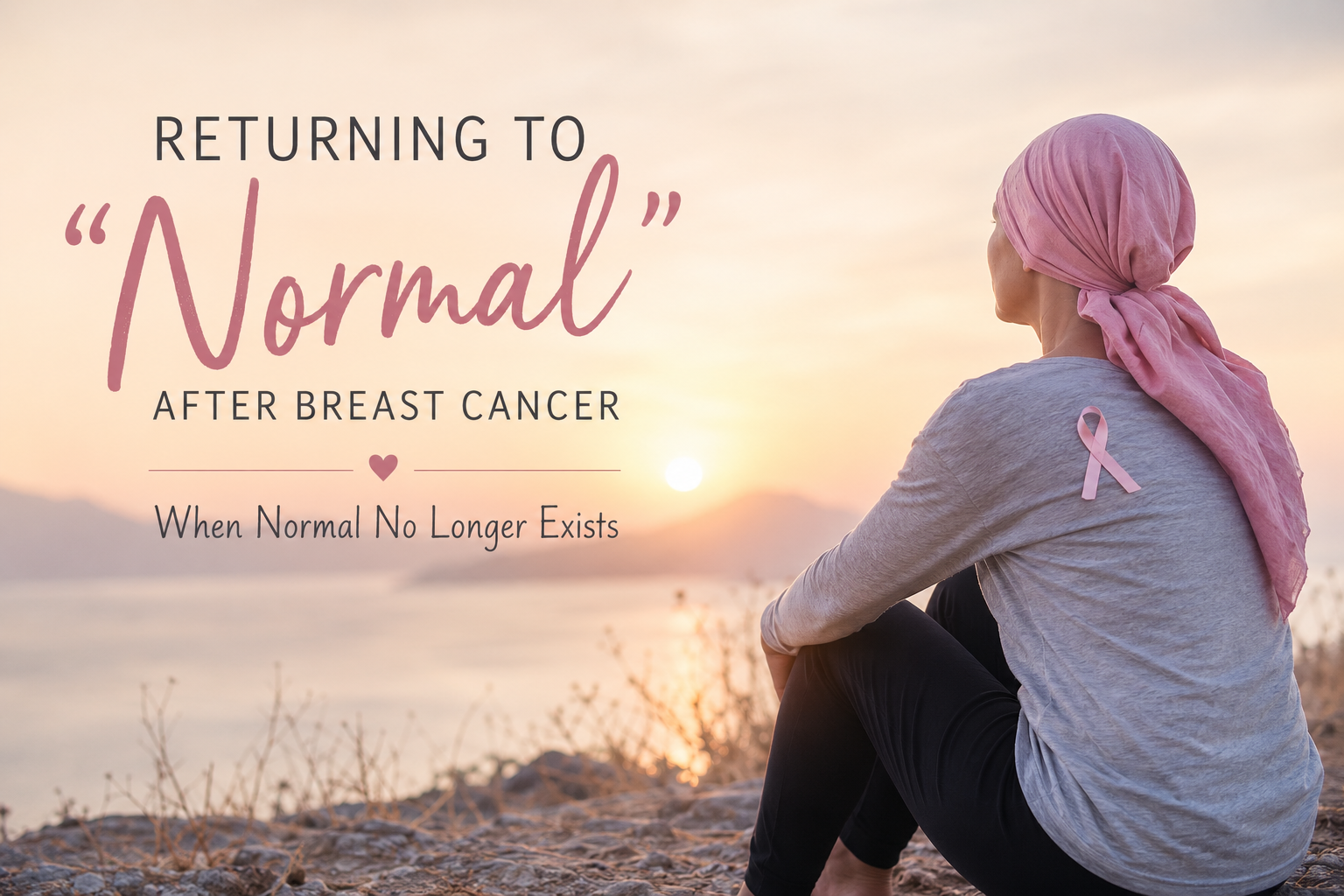
There is often an expectation that when breast cancer treatment ends, life begins returning to normal.
The appointments become less frequent. The surgeries are over. Friends and family breathe a little easier. People congratulate you on making it through treatment and may even say things like, “Now you can get back to your life.”
But what if the life you’re returning to doesn’t feel like the one you left?
For many breast cancer survivors, finishing treatment isn’t a simple return to normal. Your body may have changed. Your relationship with it may have changed. Your priorities, fears, relationships, energy, confidence, and sense of the future may feel different too.
Sometimes the hardest part is realizing that the old version of “normal” may no longer exist.
And figuring out what comes next can take time.
Everyone Else May Be Ready to Move On Before You Are
During treatment, there is usually a clear objective: get through the next appointment, procedure, scan, infusion, or surgery.
There is something to focus on.
Then treatment ends.
To the people around you, this can look like the finish line. They may be relieved and excited to see you return to work, travel, exercise, socialize, and do all the things you used to do.
But emotionally, you may still be processing what happened.
You have spent months—or sometimes years—living with decisions and experiences most people never expect to face. The fact that active treatment has ended doesn’t mean your mind immediately catches up.
You don’t owe anyone an instant return to your old life.
Your Body May Feel Familiar and Unfamiliar at the Same Time
Breast cancer can leave visible reminders.
There may be scars from a lumpectomy or mastectomy. You may have undergone reconstruction or chosen flat closure. Your breasts may look or feel different. Sensation can change. Weight may fluctuate. Hair may grow back differently.
Some changes are obvious to other people.
Many aren’t.
You can be fully dressed, walking through the grocery store looking exactly like everyone else, while being intensely aware that your body underneath your clothes isn’t the same body you had before cancer.
Looking in the mirror can bring complicated emotions.
You might feel grateful.
You might feel angry.
You might feel proud of your scars one day and wish they weren’t there the next.
You might simply miss your old body.
None of those feelings have to cancel out the others.
Missing Your Old Body Doesn’t Mean You Aren’t Grateful to Be Here
Survivors are sometimes placed in an uncomfortable position where gratitude is expected to override everything else.
You’re alive. Treatment worked. Shouldn’t that be enough?
But gratitude and grief can exist together.
You can be deeply grateful to have survived while also grieving the breasts you lost, the sensation that disappeared, your hair, your fertility, your physical strength, or simply the feeling of living in a body that had never been through cancer.
You don’t have to compare those losses with survival.
They are different things.
Allowing yourself to acknowledge what changed doesn’t diminish what you survived.
The Fear Doesn’t Necessarily Disappear When Treatment Ends
Before cancer, an ache might have simply been an ache.
After cancer, it can become a question.
A strange pain, an upcoming scan, an annual mammogram, or even hearing about someone else’s diagnosis can bring back fears you thought you had put behind you.
This can be particularly difficult because people around you may assume that once treatment ends, the danger—and therefore the fear—is gone.
But survivorship often involves learning how to live with uncertainty without allowing it to control every day.
That balance rarely happens overnight.
Your Relationship With Time May Change
Cancer has a way of making time feel different.
Things that once seemed urgent may suddenly feel unimportant. Things you assumed you would “get around to someday” may feel much more immediate.
Some survivors make major changes after treatment.
Others don’t.
You don’t have to quit your job, travel the world, repair every relationship, or transform your life because you survived cancer.
Sometimes returning to ordinary life is exactly what someone wants.
Making breakfast. Going to work. Walking the dog. Complaining about traffic. Watching television on the couch.
Ordinary can feel incredibly valuable after life has been anything but ordinary.
Relationships Can Feel Different Too
Cancer doesn’t happen in isolation.
Partners, children, parents, friends, and coworkers experience parts of it alongside you, but they don’t experience it from inside your body.
Some relationships become stronger.
Others become more complicated.
You may discover that certain people showed up in ways you never expected, while others disappeared when things became difficult.
Even good relationships can change.
A partner may be afraid of hurting you. Intimacy may feel different after surgery. You may feel uncomfortable being seen naked. Or perhaps you feel more comfortable with your body than you expected.
There is no universal response.
The person you were before cancer and the person emerging afterward are connected—but they don’t have to be identical.
You Don’t Have to Love Your Changed Body
There is a lot of pressure around “loving your scars” and celebrating the body that carried you through cancer.
That message can be empowering for some survivors.
For others, it can feel like another expectation.
You are allowed to love your scars.
You are allowed to dislike them.
You are allowed to feel completely neutral about them.
You can want reconstruction, choose flat closure, wear a prosthesis, change your appearance, or do absolutely nothing.
Your relationship with your body doesn’t have to become inspirational to be healthy.
Sometimes acceptance simply means reaching a point where your body can exist without demanding so much of your emotional attention.
Finding Yourself Again May Not Mean Becoming Your Old Self
It is natural to want the person you were before cancer back.
But after a major life experience, returning to exactly who you were may not be possible—or even necessary.
You have lived through something that changed your understanding of your body and perhaps your life.
Finding yourself again can mean deciding which parts of your old life you want to reclaim and which parts you are ready to leave behind.
Maybe you become more protective of your time.
Maybe you worry less about what other people think.
Maybe you become more cautious.
Maybe you become more adventurous.
Or maybe you simply want your ordinary routines back.
There isn’t a correct version of survivorship.
Healing Doesn’t Follow the Treatment Calendar
Medical treatment has dates.
Your emotional recovery doesn’t.
There may be a final chemotherapy session, final radiation treatment, final surgery, or final reconstruction appointment. There is rarely a single day when someone tells you that you have officially finished processing everything that happened.
Healing can move forward and backward.
You may feel fantastic for months and then unexpectedly struggle around the anniversary of your diagnosis.
You might think you’ve accepted changes to your body and suddenly feel differently when getting dressed, becoming intimate with someone, or seeing an old photograph.
That doesn’t mean you’re moving backward.
It means recovery isn’t a straight line.
Maybe the Goal Isn’t Getting Back to Normal
“Getting back to normal” sounds comforting because normal is familiar.
But after breast cancer, trying to recreate life exactly as it existed before diagnosis can sometimes become its own source of frustration.
Perhaps there is another way to think about it.
Instead of asking:
When will I feel normal again?
You might eventually begin asking:
What feels normal to me now?
The answer may change several times.
Your new normal doesn’t have to be better than your old life. It doesn’t have to come with a profound lesson about cancer. And you certainly don’t have to be grateful for everything that happened.
It simply needs to become a life that feels like yours again.
You Are Allowed to Take Your Time
Surviving breast cancer doesn’t require you to immediately become fearless, positive, grateful, or transformed.
Sometimes survivorship is much quieter than that.
It’s getting dressed without thinking about your scars.
It’s realizing you went an entire afternoon without thinking about cancer.
It’s becoming comfortable with your reflection again—or simply no longer analyzing it every time you pass a mirror.
It’s making plans months into the future without immediately wondering whether you’ll be able to keep them.
And slowly, the life that initially felt unfamiliar starts feeling like your life.
Maybe you never return to the person you were before breast cancer.
But over time, you can become familiar with the person you are now.
And perhaps that—not returning to the old normal—is what moving forward actually looks like.