
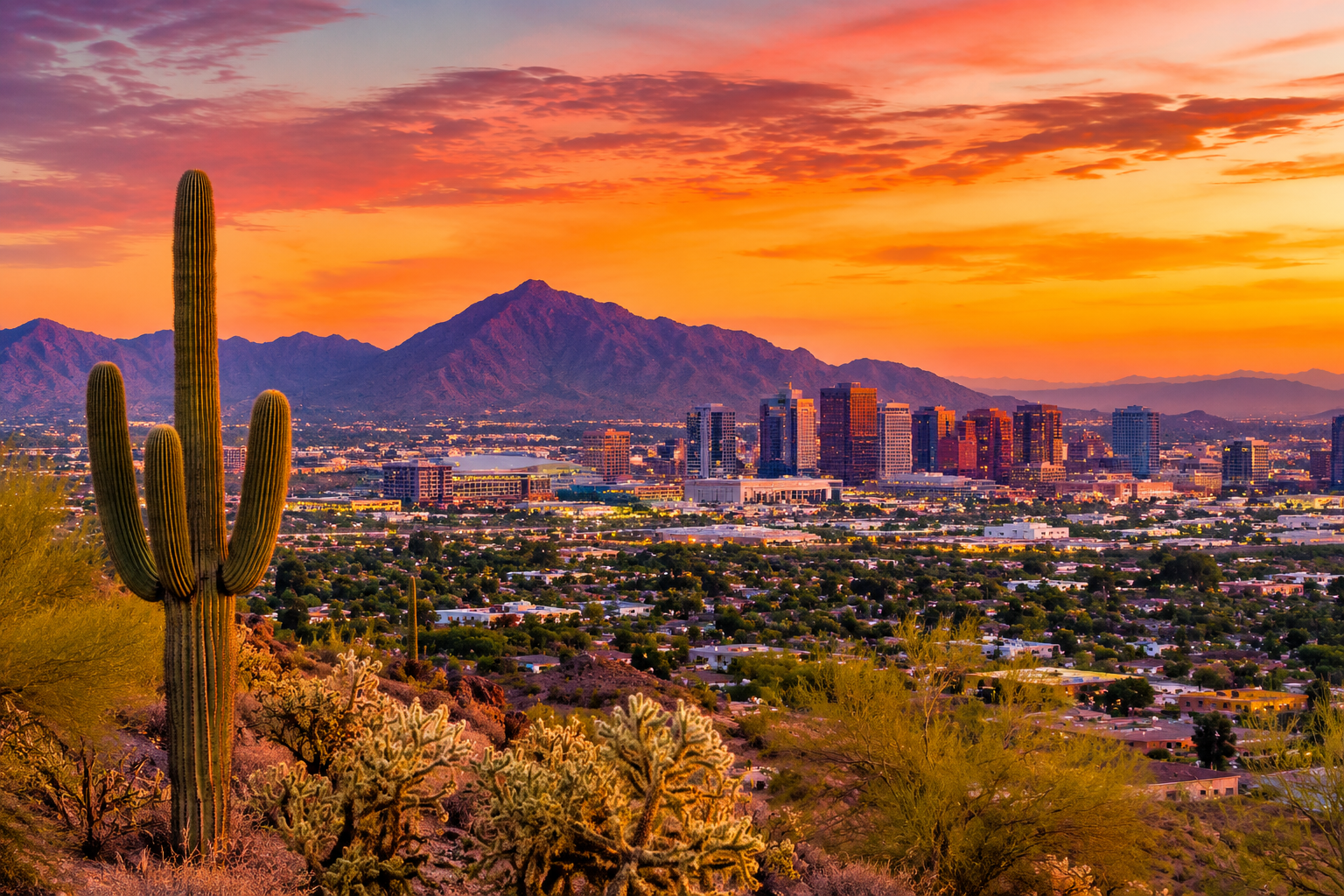
Most first-time visitors arrive in Phoenix expecting scorching temperatures, cacti, and endless suburban sprawl.
They’re not entirely wrong.
Phoenix is hot, especially in the summer, and the city stretches for miles in every direction. But spend a few days here and you’ll discover much more: mountain trails hidden within the city, world-class museums, historic desert towns nearby, and sunsets that stop people in their tracks.
The biggest mistake visitors make is treating Phoenix as the destination. The smartest travelers use it as a gateway to explore one of the most geographically diverse regions in North America.
The First Thing You Need to Understand: The Desert Is Serious
Whether you’re visiting in January or July, Arizona’s desert deserves respect.
The dry climate can be deceptive. Unlike humid climates where sweat lingers on your skin, Phoenix often evaporates moisture so quickly that people don’t realize how much water they’re losing.
Locals know that hydration starts before the adventure begins. If you’re heading out for a hike, carry more water than you think you’ll need and turn around sooner than your instincts tell you.
The desert is beautiful, but it doesn’t negotiate.
Why Phoenix Is One of America’s Most Underrated Outdoor Cities
Few major cities place dramatic mountain landscapes directly inside their urban core the way Phoenix does.
Look at a map and you’ll notice something unusual: mountains aren’t outside the city—they’re woven through it.
Camelback Mountain dominates the skyline and offers one of the most famous hikes in Arizona. Piestewa Peak provides sweeping views across the Valley of the Sun, while South Mountain Park is one of the largest municipal parks in the United States.
The reward isn’t just the exercise.
It’s standing on a rocky summit and realizing you’re looking across an entire metropolitan area surrounded by desert, mountains, and endless horizon.
For visitors who prefer something less strenuous, Hole in the Rock offers one of the easiest ways to catch a classic Arizona sunset.
The Museums That Surprise Everyone
Ask people what they expect from Phoenix, and “world-class museums” rarely makes the list.
That changes quickly.
The Musical Instrument Museum has earned an international reputation for good reason. Instead of displaying instruments behind glass and asking visitors to admire them from a distance, it creates an immersive experience where you can hear music from cultures around the world as you move through the exhibits.
Even people who don’t consider themselves “museum people” often leave impressed.
The Heard Museum provides a different perspective, focusing on Native American history, art, and culture. It’s one of the best places in the country to understand the Indigenous heritage that shaped the American Southwest long before Phoenix existed.
For architecture enthusiasts, Taliesin West offers a fascinating look into the desert vision of Frank Lloyd Wright.
The Real Phoenix Is Found After Sunset
Summer temperatures have shaped local culture in a unique way.
During the hottest months, much of the city comes alive after dark.
Evening walks through Roosevelt Row reveal colorful murals, galleries, local vendors, and creative energy that many visitors never expect from Phoenix. Monthly art events attract thousands of people and showcase the city’s growing arts scene.
Music fans can find everything from underground punk shows to major touring acts, while local venues continue to support independent artists year-round.
The city’s nightlife isn’t concentrated in a single downtown district either.
Downtown Phoenix, Tempe, and Old Town Scottsdale each offer distinctly different experiences, giving visitors several neighborhoods to explore.
The Water Side of the Desert
One of the biggest surprises for newcomers is discovering how much water-based recreation exists in the middle of the desert.
The Salt River has become a favorite local escape, especially during warmer months. Floating down the river while surrounded by desert scenery feels almost contradictory—and that’s part of the appeal.
Nearby lakes such as Saguaro Lake and Canyon Lake offer boating, kayaking, paddleboarding, and opportunities to see the Sonoran Desert from a completely different perspective.
For visitors expecting endless sand and rock, these waterways often become the highlight of the trip.
The Day Trips That Make Phoenix Special
Phoenix is impressive on its own.
What truly elevates it is what sits within a few hours’ drive.
Sedona
If Arizona had a postcard image, it would probably be Sedona.
Massive red rock formations rise from the desert floor, creating landscapes that seem almost fictional. Hiking trails, scenic drives, and dramatic viewpoints make it one of the state’s most visited destinations.
Flagstaff
Just a couple of hours north, the environment changes completely.
Pine forests replace cacti. Temperatures drop significantly. The atmosphere feels more like Colorado than Arizona.
Many visitors are shocked by how quickly Arizona transforms once elevation increases.
Prescott
Historic downtown streets, old saloons, mountain scenery, and a slower pace create a completely different experience from Phoenix. It offers a glimpse into Arizona’s frontier history while remaining lively and welcoming.
Jerome
Perched on a mountainside, this former mining town combines history, art galleries, and spectacular views. Few places in Arizona feel quite like it.
The Grand Canyon
No list would be complete without mentioning one of the world’s most famous natural wonders.
Photos help.
Standing at the rim is something else entirely.
What Phoenix Does Better Than Most Cities
Many destinations are built around a single attraction.
Phoenix succeeds because it offers contrast.
You can spend the morning hiking through desert landscapes, the afternoon exploring world-class museums, the evening enjoying award-winning Mexican cuisine, and the next day driving into pine forests or red rock canyons.
Few American cities provide that level of variety within such a short distance.
Phoenix may not have the immediate charm of a coastal city or the walkability of a historic European destination.
What it offers instead is access—to landscapes, experiences, cultures, and adventures that feel uniquely Southwestern.
Give it a few days.
The desert tends to win people over.