
Receiving a breast cancer diagnosis means your attention is immediately consumed by medical appointments, surgical decisions, and a steep learning curve of clinical terminology. When you are preparing for a lumpectomy or mastectomy, your focus belongs exactly where it is — on clear margins and getting well.
But there is one small, practical step worth taking before surgery: photograph your natural areolas and nipples now.
If you’ve already had surgery and don’t have these photos, you are not alone and you are not without options — this article still applies to you, and a skilled artist can work with what you have. But if surgery is still ahead, capturing these details now creates an invaluable reference for the road ahead.
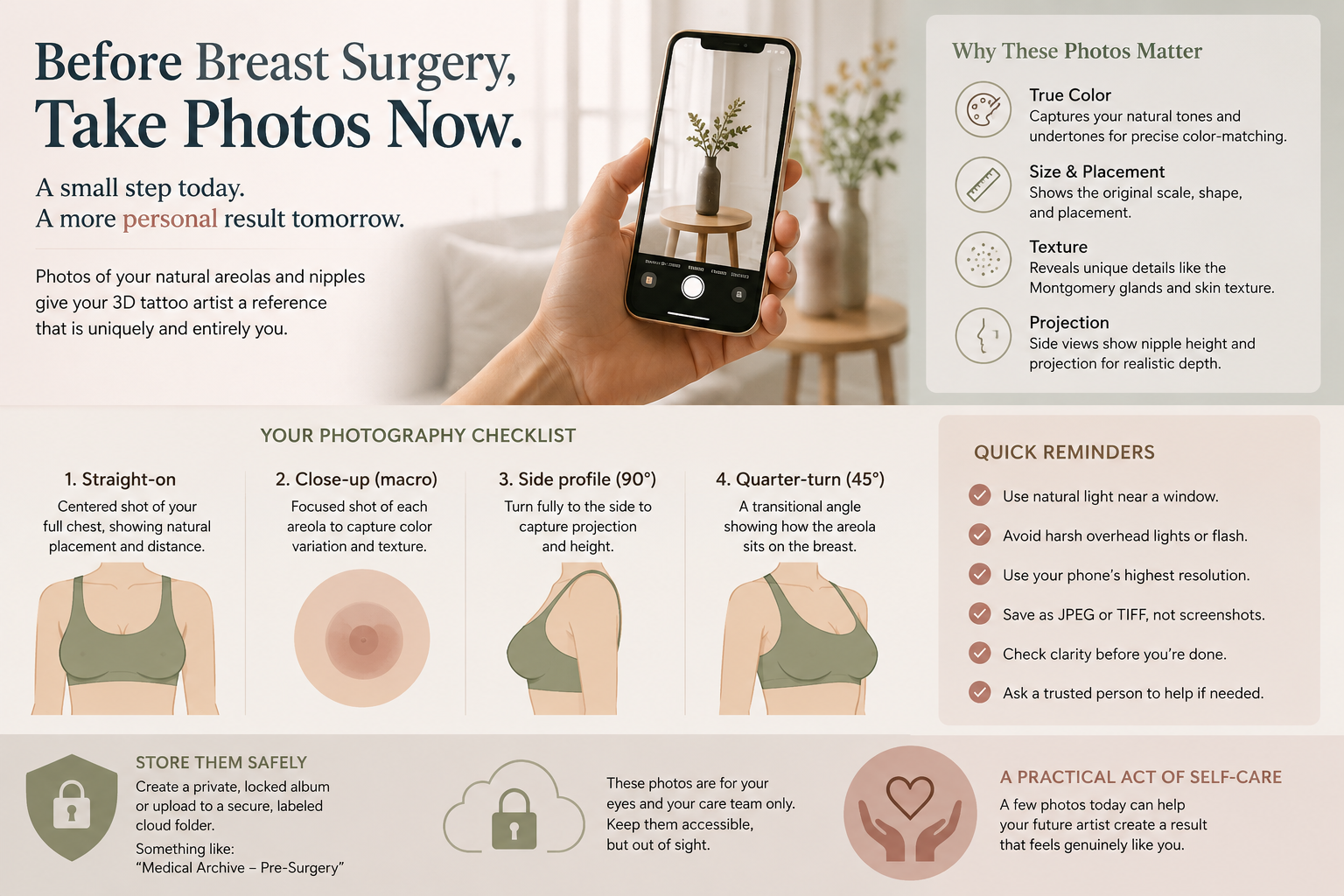
Why These Photos Matter to Your 3D Tattoo Artist
A professional 3D areola tattoo artist doesn’t tattoo a generic shape. They use advanced shading, highlights, and color theory to create a hyper-realistic illusion of depth and projection. Having a record of your original anatomy gives them something no amount of skill can substitute: a reference that is specifically, entirely you.
Here’s what those photos tell your artist:
True Color: Your natural areola may carry cool pink tones, warm honey hues, or deep chestnut shades — often several at once. A photograph shows exactly how your skin naturally behaves, making color-matching far more precise than working from memory or guesswork.
Size and Placement: Photos give your artist a clear reference for the original scale of your areola relative to your breast, and the natural shape of its borders.
Texture: No two nipples are identical. Some are circular, others slightly oval. The Montgomery glands — the small raised bumps on the areola — vary significantly from person to person. Photos allow your artist to replicate those organic details rather than approximate them.
Projection: A side-profile shot captures the exact height and projection of your nipple, which tells your artist how much shadow and depth to build into the tattoo to simulate that dimension realistically.
A note for single mastectomy patients: Even if only one side is being reconstructed, photos of both breasts are valuable. Skin stretches and settles differently over an implant or flap reconstruction, and your remaining breast can shift over time. A baseline record now supports the most balanced outcome later.
When to Take Them
Take these photos as soon as possible — ideally before any pre-operative skin marking or prep, which can temporarily alter the appearance of the skin. If you’ve had a biopsy, don’t worry if the area looks slightly different than it once did. Any reference is better than none, and a good artist will account for that context.
Your Photography Checklist
You don’t need professional equipment. A modern smartphone camera is more than capable. Treat these purely as a private medical archive.
1. Find good lighting
Avoid harsh overhead bathroom lighting or direct flash, both of which wash out your skin’s natural undertones and flatten texture. Natural daylight near a window works best.
2. Take four angles for each side
- Straight-on: A centered shot of your full chest, showing natural placement and the distance between both sides.
- Close-up (macro): A focused shot of each areola individually, capturing color variation and surface texture.
- Side profile (90 degrees): Turn fully to the side to capture the nipple’s projection and height.
- Quarter-turn (45 degrees): A transitional angle that shows how the areola sits on the curve of the breast.
3. Check clarity
Make sure each photo is in focus and well-lit before putting your phone down. If you’re comfortable, ask a trusted person to take them for you to avoid awkward angles or camera shake.
4. Shoot in your phone’s highest resolution
Go into your camera settings and ensure you’re shooting at full resolution. Save as JPEG or TIFF — not screenshots. When the time comes to share them with your artist, you’ll want the original file, not a compressed version.
Storing These Photos Safely
Once taken, move these photos somewhere intentional so they don’t surface unexpectedly while you’re scrolling.
Create a private, locked album on your phone, or upload them to a secure, labeled cloud folder — something like “Medical Archive — Pre-Surgery.” This keeps them accessible when you need them without the risk of stumbling across them at the wrong moment.
When it’s time to share them with your tattoo artist, most practitioners are accustomed to receiving sensitive medical imagery and will have a preferred secure method — often an encrypted file-sharing link, a private intake form, or a direct encrypted message. You can ask about their process at your consultation. You are never obligated to send anything before you feel ready and comfortable.
These photos are a practical act, nothing more and nothing less. By setting them aside now, you’re giving your future artist the clearest possible starting point — and giving yourself the best chance of a result that feels genuinely like you.