
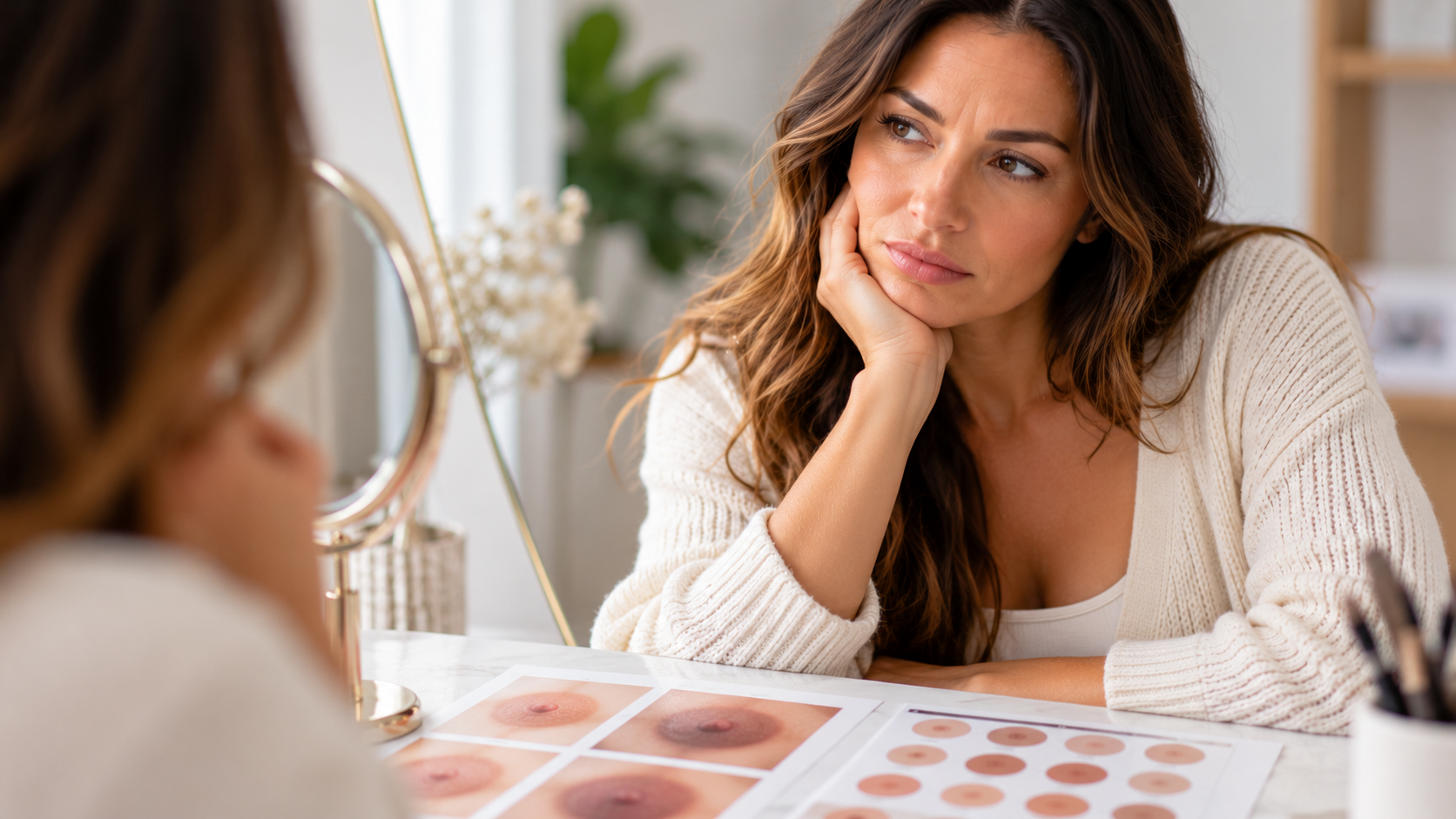
Nipple blushing is supposed to enhance the natural appearance of your nipples and areolas. But what happens when the results are nothing like you expected?
Perhaps your areolas were naturally very light, and you wanted just a little more color. Instead, the tattoo healed too dark, the edges look unnatural, or the pigmentation appears flat and artificial.
For some people, the experience is even more frustrating because the procedure leaves behind scarring or uneven skin texture.
If you’re unhappy with nipple blushing results, you may be wondering: Can a bad nipple tattoo be corrected, or is the damage permanent?
The answer depends on several factors, including the existing pigment, skin condition, and whether scarring is present.
What Is Nipple Blushing?
Nipple blushing is a cosmetic tattooing procedure designed to enhance the natural color of the nipples and areolas.
It typically involves adding pigment to create a darker, more even, or more defined appearance.
Unlike 3D nipple restoration, which is often performed after mastectomy or breast reconstruction, nipple blushing generally focuses on enhancing existing nipple and areola tissue.
When performed appropriately, the goal is usually a subtle, natural-looking result.
However, the final appearance can vary depending on pigment selection, application technique, skin characteristics, and healing.
What Can Go Wrong With Nipple Blushing?
Not every nipple blushing procedure produces the desired outcome.
Some of the most common concerns include:
1. Areola Tattoo Looks Too Dark
One of the biggest complaints is pigmentation that appears significantly darker than expected.
Someone who originally wanted a soft pink or light brown enhancement may end up with a much deeper shade.
Fresh tattoos often appear darker before healing, but some results remain darker than desired.
2. Unnatural or Fake-Looking Nipples
Natural areolas usually contain subtle variations in color and softly blended edges.
When tattoo pigment is applied too uniformly, the result can appear like a solid circle rather than natural pigmentation.
Overly sharp borders, unsuitable pigment colors, or insufficient shading may contribute to an artificial appearance.
3. Patchy or Uneven Pigmentation
Some nipple tattoos heal with inconsistent color.
Certain areas may retain more pigment than others, leaving visible patches or uneven saturation.
4. Scarring After Nipple Blushing
Scarring is a more serious concern.
Tattooing involves penetrating the skin, and excessive trauma, infection, or healing complications can sometimes contribute to scar formation.
Scars may appear raised, depressed, shiny, or different in texture from the surrounding skin.
Unlike uneven pigmentation, scarring cannot simply be covered or erased with more tattoo ink.
Why Does My Areola Tattoo Look Fake?
One reason nipple tattoos can appear unnatural is that real areolas rarely have perfectly uniform pigmentation.
Natural areolas often feature:
-
Soft, irregular borders
-
Subtle variations in color
-
Gradual transitions between lighter and darker areas
-
Pigmentation that complements the surrounding skin tone
A tattoo that ignores these details may appear overly defined or artificial.
This is why experience with realistic nipple and areola pigmentation matters, especially when attempting to correct an existing tattoo.
Can a Bad Nipple Tattoo Be Fixed?
Some unsatisfactory nipple tattoos can be improved, but not every result can be corrected through additional tattooing.
The available options depend on the original tattoo and the condition of the skin.
For example, a healed areola tattoo with minor uneven pigmentation may be suitable for carefully planned color blending.
An overly sharp border might sometimes be visually softened through specialized shading.
However, a tattoo that is extremely dark, heavily saturated, or accompanied by significant scarring may require a different approach.
Adding more pigment is not always the solution.
In some situations, additional tattooing could make the appearance worse.
A professional assessment is essential before attempting corrective work.
Can You Lighten an Areola Tattoo That’s Too Dark?
This is one of the most important questions for people unhappy with nipple blushing.
Unfortunately, adding lighter-colored tattoo ink over dark pigment does not reliably lighten the original tattoo.
Tattoo pigments sit within the skin, and layering lighter pigment over darker ink can create unpredictable colors as the tattoo heals.
Skin-colored camouflage ink may also change appearance over time.
If your areola tattoo is significantly darker than you wanted, a dermatologist experienced in tattoo removal may be able to evaluate whether a removal technique is appropriate.
However, removal procedures also carry risks, including pigment changes and scarring, particularly on delicate nipple and areola tissue.
The safest option depends on your individual circumstances.
What If Nipple Blushing Left Scars?
If your nipple blushing procedure caused scarring, the first priority should be evaluating the condition of your skin.
Tattooing can change the appearance of pigmentation, but it cannot flatten raised scars, restore damaged skin texture, or reverse scar formation.
Scar tissue may also retain pigment unpredictably.
If you have raised scars, persistent redness, pain, or other concerning changes, consult a dermatologist or qualified healthcare professional before considering additional tattooing.
Depending on the type of scar, medical scar treatments may be more appropriate than corrective pigmentation.
Can 3D Areola Tattooing Make a Bad Tattoo Look More Natural?
In selected cases, techniques used in 3D nipple and areola restoration may help improve the appearance of an existing tattoo.
These techniques can include carefully chosen pigment shades, realistic shading, and softer transitions between colors.
For example, if an areola tattoo has uneven pigmentation but the skin is healthy and fully healed, corrective shading might help create a more balanced appearance.
However, 3D tattooing cannot reliably cover extremely dark pigment with lighter colors or eliminate scar tissue.
Some existing tattoos may not be suitable for correction.
An experienced specialist should explain what can realistically be improved and when further tattooing should be avoided.
How Long Should You Wait Before Correcting Nipple Blushing?
If you’ve recently had nipple blushing, avoid rushing into another procedure.
Fresh tattoo pigmentation can change considerably during healing.
Redness, swelling, peeling, and temporary changes in color may affect the initial appearance.
It’s important to allow the skin to heal fully before evaluating the final result.
If scarring or complications occurred, additional healing time and medical evaluation may be necessary.
There is no universal waiting period that guarantees the skin will be ready for corrective tattooing.
Considering Nipple Tattoo Correction With Jayd Hernandez
Jayd Hernandez specializes in realistic 3D nipple and areola restoration in Gilbert, Arizona.
Her work emphasizes natural-looking pigmentation, detailed shading, and individualized color selection.
If you’re unhappy with previous nipple blushing results, a consultation can help you discuss your concerns and understand whether restorative pigmentation might be appropriate.
Depending on the existing tattoo and skin condition, further tattooing may or may not be advisable.
The goal should always be a realistic assessment rather than promising that every unsuccessful tattoo can be corrected.
Final Thoughts: Don’t Rush to Cover a Bad Nipple Tattoo
An unsuccessful nipple blushing procedure can be emotionally frustrating, especially when you originally wanted only a subtle enhancement.
Whether your tattoo looks too dark, has unnatural borders, or resulted in scarring, it’s important to understand your options before undergoing another procedure.
Some pigmentation irregularities may be improved with corrective tattooing. Others may require medical evaluation, removal consultation, or simply allowing more time for the skin to heal.
The most important step is finding out what is realistically possible for your particular situation.
If you’re exploring nipple and areola restoration options, you can contact Jayd Hernandez to discuss your concerns.