Experiencing nipple necrosis after breast surgery can be physically and emotionally challenging, especially when the healing process leaves visible scars, changes in nipple appearance, or areas of missing pigmentation.
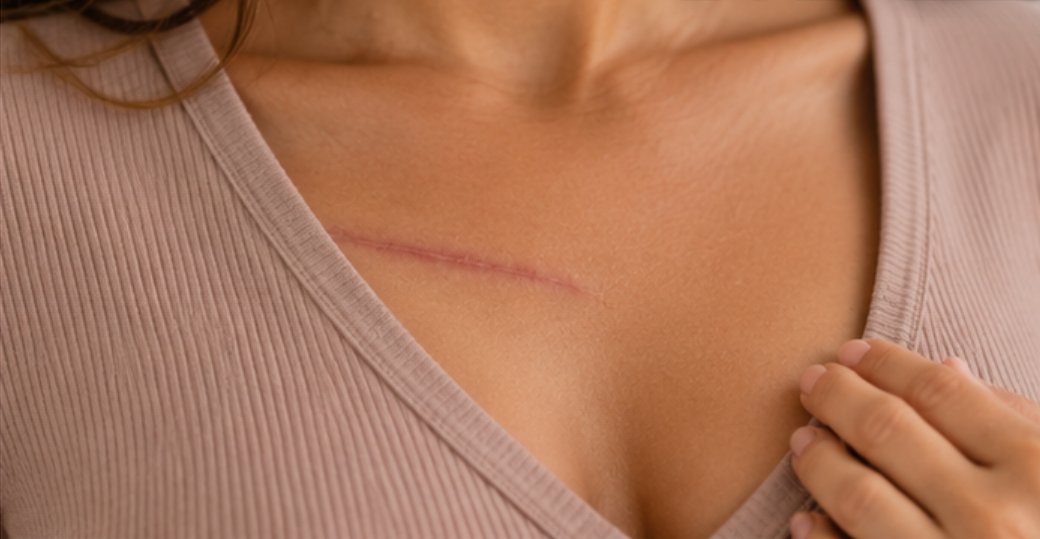
For some women, the concern isn’t limited to the nipple itself. Surgical scars may sit higher on the breast than expected, making them visible when wearing low-cut clothing or bending forward. If additional surgery, such as breast augmentation, is planned, there may also be concerns about how the breast’s changing shape could affect the appearance and positioning of existing scars.
If you’ve experienced nipple necrosis following breast surgery, you may be wondering whether 3D nipple tattooing or restorative areola tattooing can help camouflage scars and restore a more natural-looking appearance.
While medical tattooing cannot physically remove scars or replace lost tissue, specialized pigmentation techniques may help recreate the visual appearance of a nipple and areola, improve uneven coloration, and make certain surgical scars less noticeable.
Understanding how the process works, what results are realistic, and when to consider tattooing can help you make an informed decision.

What Is Nipple Necrosis After Breast Surgery?
Nipple necrosis occurs when the blood supply to the nipple or surrounding areola tissue becomes insufficient, causing some or all of the affected tissue to die.
It is a recognized complication that can occur following certain breast procedures, including breast reduction, breast lift, breast reconstruction, and mastectomy.
The severity of nipple necrosis can vary considerably.
In some cases, only a small portion of the nipple or areola is affected. In more severe cases, significant tissue damage may result in partial or complete loss of the nipple.
As the affected area heals, individuals may experience changes such as:
-
Partial or complete loss of nipple tissue
-
Changes in areola shape or size
-
Areas of missing or uneven pigmentation
-
Visible surgical scars
-
Differences in nipple positioning or symmetry
-
Changes in the texture or appearance of the surrounding skin
The healing process can leave the breast looking different from what was originally expected.
For individuals who have undergone surgery to improve or restore their breast appearance, these changes can be particularly frustrating.
Active or suspected nipple necrosis requires evaluation by a medical professional. Restorative tattooing is an option to consider only after the affected tissue has healed adequately and a treating clinician has confirmed that tattooing is appropriate.
Why Nipple Necrosis and Surgical Scars Can Affect Confidence
The physical changes caused by nipple necrosis can sometimes have an emotional impact that extends beyond the surgical recovery period.
A person may feel uncomfortable with the appearance of their breasts, avoid certain clothing, or become more self-conscious during everyday activities.
For example, a surgical scar positioned high on the breast may become visible when wearing a V-neck shirt, bending forward, or choosing clothing with a lower neckline.
Even when the scar has healed completely, its location, pigmentation, or contrast with the surrounding skin may make it difficult to conceal.
For some individuals, these concerns can affect how comfortable they feel with their bodies.
It’s important to recognize that the desire to improve the appearance of surgical scars or restore nipple pigmentation is not simply about aesthetics. For many people, it is connected to feeling more comfortable, confident, and at ease with their appearance after surgery.
Restorative nipple and areola tattooing may provide an option for addressing some of these visible changes without undergoing an additional procedure solely to recreate nipple pigmentation.

How Can 3D Nipple Tattooing Help After Nipple Necrosis?
3D nipple tattooing is a specialized restorative tattooing technique designed to recreate the visual appearance of a natural nipple and areola.
Rather than relying on a single pigment color, an experienced restorative tattoo artist uses carefully selected shades, highlights, shadows, and detailed color blending to create the illusion of depth.
This technique can be particularly helpful when nipple necrosis has resulted in partial or complete loss of nipple tissue.
Even when the skin is relatively flat, realistic shading can create the appearance of nipple projection without physically rebuilding the missing tissue.
Depending on the condition of the skin and the extent of tissue loss, restorative tattooing may help:
-
Recreate the appearance of a missing nipple
-
Restore pigmentation to areas affected by tissue damage
-
Improve uneven or irregular areola borders
-
Create a more balanced appearance between both breasts
-
Blend certain areas of discoloration into the surrounding areola
-
Improve the visual appearance of existing nipple tissue
Every situation is different.
Someone who has experienced partial nipple necrosis may have remaining tissue that can serve as a reference for the tattoo design.
A person who has lost the entire nipple may require a more comprehensive 3D restoration to recreate the visual appearance of the nipple and areola.
The final design should consider the individual’s natural skin tone, breast anatomy, existing scar tissue, and desired appearance.
Can Areola Tattooing Camouflage Scars After Breast Surgery?
One of the most common questions about restorative areola tattooing is whether it can help hide surgical scars.
The answer depends on the scar’s location, size, texture, pigmentation, and relationship to the nipple and areola.
Areola tattooing cannot physically remove scars, flatten raised tissue, or change the skin’s texture. However, carefully applied pigments may help reduce the visual contrast between certain scars and the surrounding skin.
For example, if a scar passes through the areola or sits close to its border, restorative tattooing may help incorporate part of the scar into a more natural-looking areola design.
By adjusting the pigmentation and visual borders, the artist may be able to make some irregularities less noticeable.
Scars located farther away from the areola present a different challenge.
If a surgical scar extends significantly above the nipple, creating a larger areola simply to cover the scar may produce an unnatural appearance.
In these situations, the artist must assess whether localized scar camouflage, nipple restoration, or a combination of techniques could provide a suitable improvement.
Some scars may not be appropriate for tattooing, and certain scars may remain visible even after pigmentation.
An individualized assessment is essential for determining what can realistically be achieved.
What If the Surgical Scar Is Positioned High on the Breast?
A scar located higher than expected can be particularly noticeable, especially when it sits outside the natural borders of the areola.
This may happen following breast surgery when the incision placement, healing process, or changes in breast shape leave a visible scar above the nipple.
For individuals who experience nipple necrosis, the affected tissue and subsequent healing may also alter the appearance of the nipple and surrounding skin.
When considering restorative tattooing, the scar’s position is just as important as its color.
A scar that falls within the planned areola design may be easier to visually incorporate than one extending well above it.
If the scar sits too far from the natural areola, extending the tattoo to cover it may not be aesthetically appropriate.
In some cases, separate scar camouflage techniques may be worth discussing, although their suitability depends on the scar’s characteristics and the surrounding skin.
The objective should be to improve the overall appearance of the breast while maintaining natural-looking proportions, rather than attempting to conceal every visible mark at the expense of the final design.
Should You Get an Areola Tattoo Before or After Breast Augmentation?
If you’re planning additional breast surgery, such as breast augmentation, the timing of restorative areola tattooing is an important consideration.
Breast augmentation can change the breast’s shape, fullness, and skin tension. These changes may also affect the apparent position of existing scars, nipples, and areolas.
However, the exact changes are not predictable for every individual.
For someone who already has a high-positioned surgical scar, it is understandable to be concerned that additional breast volume could make the scar appear more prominent.
This possibility should be discussed with the plastic surgeon before making decisions about restorative tattooing.
In many situations, it may be preferable to wait until after the planned breast augmentation and subsequent healing before proceeding with permanent nipple or areola tattooing.
There are several reasons for this.
Breast shape may change. A tattoo designed before augmentation may appear differently positioned or proportioned after the breast changes shape.
Scar appearance may evolve. Additional surgery and healing can affect the appearance of existing scars and may introduce new ones.
Tattoo placement requires stability. Designing a realistic nipple and areola is generally easier when the breast has reached a relatively stable postoperative shape.
Healing must be complete. Tattooing over recently operated or compromised tissue can increase the risk of complications and unpredictable pigment retention.
If you’re considering breast augmentation after nipple necrosis, discuss your plans with your plastic surgeon and restorative tattoo artist.
Your surgeon can help determine when the breast tissue has healed sufficiently and whether additional procedures could affect the proposed tattoo placement.
How Long Should You Wait Before Tattooing Surgical Scars?
Restorative tattooing should not be performed over actively healing wounds, untreated necrotic tissue, or areas that have not adequately recovered from surgery.
Scar tissue changes over time.
During healing, scars may gradually become softer, flatter, and less visibly red or discolored.
The appropriate waiting period varies depending on the procedure, the severity of the tissue damage, scar characteristics, and individual healing.
Some individuals may require a substantially longer recovery period, particularly following complications such as nipple necrosis.
For this reason, there is no single waiting period that is appropriate for everyone.
Before proceeding with nipple or areola tattooing, the affected tissue should be medically assessed and sufficiently healed.
A consultation can then help determine whether the scar tissue is suitable for pigmentation and whether the desired result is realistic.
Can 3D Areola Tattooing Restore a Natural-Looking Nipple?
One of the advantages of 3D nipple tattooing is the ability to create the visual appearance of a nipple even when natural projection has been lost.
This is achieved through artistic techniques rather than physical reconstruction.
The tattoo artist uses different pigment tones to reproduce the appearance of natural highlights, shadows, borders, and subtle skin variations.
Darker shades can create the illusion of recessed areas, while lighter pigments can simulate highlights on raised surfaces.
When carefully combined, these details may create a convincing three-dimensional appearance on relatively flat skin.
For individuals who have experienced nipple necrosis, this can offer an alternative to surgical nipple reconstruction when the goal is primarily visual restoration.
However, tattooing does not recreate the physical projection, sensation, or biological function of a natural nipple.
The result is an optical illusion designed to improve appearance.
What Results Can You Realistically Expect From Scar Camouflage and Nipple Restoration?
Restorative tattooing can provide meaningful visual improvements for some individuals, but the results depend on several factors.
These include the amount of remaining nipple tissue, the condition of the skin, scar texture, existing pigmentation, and the body’s response to tattooing.
Flat, mature scars may respond differently from raised, indented, or heavily textured scars.
Scar tissue may also retain pigment differently from unaffected skin.
Some individuals may achieve a noticeable improvement in color consistency and nipple appearance, while others may continue to have visible scars or irregularities.
Very dark scars, heavily textured tissue, or scars located far outside the natural areola area can be particularly challenging.
A qualified restorative tattoo artist should explain these limitations before treatment and avoid promising complete scar concealment.
The goal is to create the most natural-looking improvement possible for the individual’s anatomy, rather than guarantee that every scar will disappear.
Restoring Confidence After Nipple Necrosis
Recovering from an unexpected surgical complication can involve more than physical healing.
Changes in nipple appearance, visible scarring, and differences between the breasts may affect how someone feels when getting dressed, looking in the mirror, or choosing clothing.
For some people, restoring the visual appearance of the nipple and areola can be a meaningful part of moving forward after surgery.
Others may be primarily concerned with making a prominent scar less noticeable.
Both concerns deserve an individualized approach.
Restorative tattooing cannot reverse the original complication, but it may offer a way to improve certain visible changes without additional nipple reconstruction surgery.
The decision is personal, and the most appropriate option depends on the individual’s goals, healing, and medical circumstances.
Exploring 3D Nipple and Areola Restoration With Jayd Hernandez
Jayd Hernandez specializes in realistic 3D nipple and areola restoration, working with individuals who have experienced changes in nipple appearance following breast surgery, mastectomy, reconstruction, and other procedures.
Her approach focuses on customized designs that account for each client’s anatomy, natural skin tone, existing tissue, surgical scars, and desired appearance.
For individuals who have experienced nipple necrosis, an initial consultation can help explore whether restorative tattooing may be appropriate once the affected tissue has healed.
If you have visible scars, missing nipple pigmentation, or concerns about the appearance of your areolas, you can discuss these issues and share photographs of the treatment area during the consultation process.
If additional breast surgery is planned, such as augmentation, this information is also important when discussing the timing and design of a future tattoo.
Jayd’s private studio is located in Gilbert, Arizona, and clients from other parts of the United States can begin the consultation process remotely before considering travel.
Can Areola Tattooing Help You Feel More Comfortable With Your Appearance Again?
If you’ve experienced nipple necrosis after breast surgery, you may be dealing with changes that were never part of your original expectations.
Perhaps your nipple has lost pigmentation or projection. Maybe a surgical scar sits higher than you would like, or you’re concerned about how additional breast surgery might change its appearance.
While 3D nipple and areola tattooing cannot erase surgical scars or restore lost tissue, it may help recreate a natural-looking nipple, improve uneven pigmentation, and reduce the visibility of certain scars.
The first step is understanding what may be possible for your particular situation.
Schedule a consultation with Jayd Hernandez to discuss your goals, explore restorative tattooing options, and determine whether 3D nipple or areola tattooing may be appropriate after your breast tissue has fully healed.